
When Something Doesn't Feel Right at School

An 8-Part Guide for Parents Wondering What to Do Next
This article is Part 1 of the series, When Something Doesn't Feel Right at School. Throughout this series, we'll help you recognize patterns, understand your child's IEP, gather meaningful information, and know when it's time to take action.
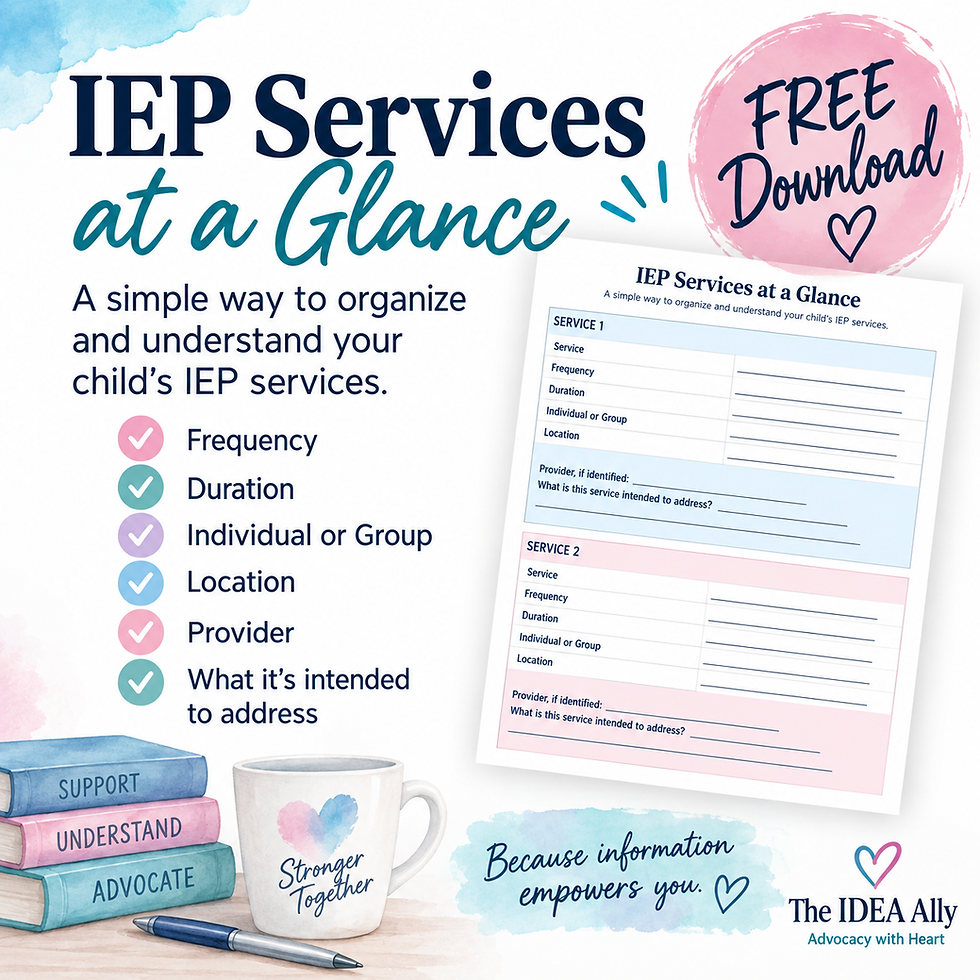
Download

September is all about settling in.
October is often about adjusting.
But by November, something important begins to happen.
The "new school year" is no longer new.
Routines have been established. Expectations are clearer. Teachers know your child better, and your child knows what each school day looks like.
That also means something else begins to emerge...
Patterns.
If concerns continue to surface week after week, it's worth taking a closer look—not because it's time to panic, but because it's time to gather information.
Over the next few weeks, we'll walk through a simple process to help you determine whether your child is making appropriate progress, whether supports are working as intended, and when it may be time to ask questions or request a meeting.
We'll cover:
Part 1: November Is When Patterns Begin to Show
Part 2: Start With the IEP
Part 3: Compare the Plan With What Is Actually Happening
Part 4: Look Beyond Grades
Part 5: Gather Information Before Contacting the Team
Part 6: Ask Questions Before Assuming the Worst
Part 7: Know When It May Be Time for a Meeting
Part 8: Don't Wait Until January
My hope is that by the end of this series, you'll feel more confident recognizing the difference between a temporary rough patch and a pattern that deserves attention.
Because the earlier concerns are identified, the easier they often are to address.
Let's begin.
November is When Patterns Begin to Show

When school first starts, almost everyone says the same thing:
"Let's give it a little more time."
And that's often good advice.
Children are adjusting to new teachers, new routines, new expectations, and sometimes even a new school.
A difficult first week—or even a difficult first month—doesn't always mean something is wrong.
But by November, something begins to change.
Patterns start to emerge.
Instead of asking, "Was today just a bad day?" you may find yourself wondering:
Is homework becoming a nightly struggle?
Is my child saying they hate school every morning?
Are accommodations still not happening consistently?
Is communication from school raising the same concerns over and over?
Does my child seem more anxious, frustrated, or exhausted than they did in September?
One isolated incident isn't usually a pattern.
Repeated concerns deserve a closer look.
This doesn't mean it's time to panic.
It means it's time to gather information.
Review your notes, emails, homework observations, progress reports, or any communication you've been saving.
Looking back often helps you see trends that are easy to miss in the middle of busy weeks.
If you notice the same concerns appearing again and again, it may be appropriate to request a conversation with your child's teacher or the CSE/IEP team.
Early conversations often prevent bigger problems later.
Remember, asking questions isn't about creating conflict.
It's about making sure your child has the support they need before small struggles become much bigger ones.
💙 Trust what you're seeing.
By November, you're no longer looking at a few difficult days—you may be seeing a pattern.
And patterns provide valuable information that can help guide the next steps.
Looking Ahead
Recognizing a pattern is only the first step.
The next question many parents ask is, "Now what?"
Before contacting the school or requesting a meeting, it's important to revisit the document that guides your child's educational program—the IEP.
In Part 2: Start With the IEP, we'll walk through how to review your child's IEP with fresh eyes and identify the services, accommodations, goals, and supports that should already be in place. Sometimes the answers you're looking for are already written into the plan.
Because before deciding whether something needs to change, it's important to know exactly what was promised in the first place.
💙 I'll see you in Part 2.
Helpful add-ons (free tools)
Next Steps and Resources:
The following websites are incredibly helpful when navigating the Special Education world.
Need help personalizing your letter or planning next steps? I offer one-on-one support—virtual anywhere in the U.S. and in-person across NY/NJ. Work with me.
About the Author
Allison Rosenberg Meyerson is a special education advocate with 30+ years in the classroom and as a literacy specialist. She is Orton-Gillingham Certified, a COPAA SEAT 1.0 graduate, and a Dyslexia Advocate. Based in Warwick, NY, she supports families across NY, NJ, and virtually nationwide through The IDEA Ally.
Contact:
Website www.TheIDEAAlly.com
Email Allison@theideaally.com


Comments