
When Something Doesn't Feel Right at School

Part 2 of an 8-Part Guide for Parents Wondering What to Do Next
Download
This article is Part 2 of the series, When Something Doesn't Feel Right at School. Throughout this series, we'll help you recognize patterns, understand your child's IEP, gather meaningful information, and know when it's time to take action.
Start with the IEP

In Part 1, we talked about how November is often when school concerns begin to form patterns.
If you've started noticing those patterns, your next step isn't to assume the worst.
It's to go back to the plan.
The Individualized Education Program (IEP) is more than paperwork. It's the roadmap that outlines the supports your child is supposed to receive throughout the school year.
Before asking why something isn't working, it's important to know what was supposed to happen in the first place.
Begin With the Services
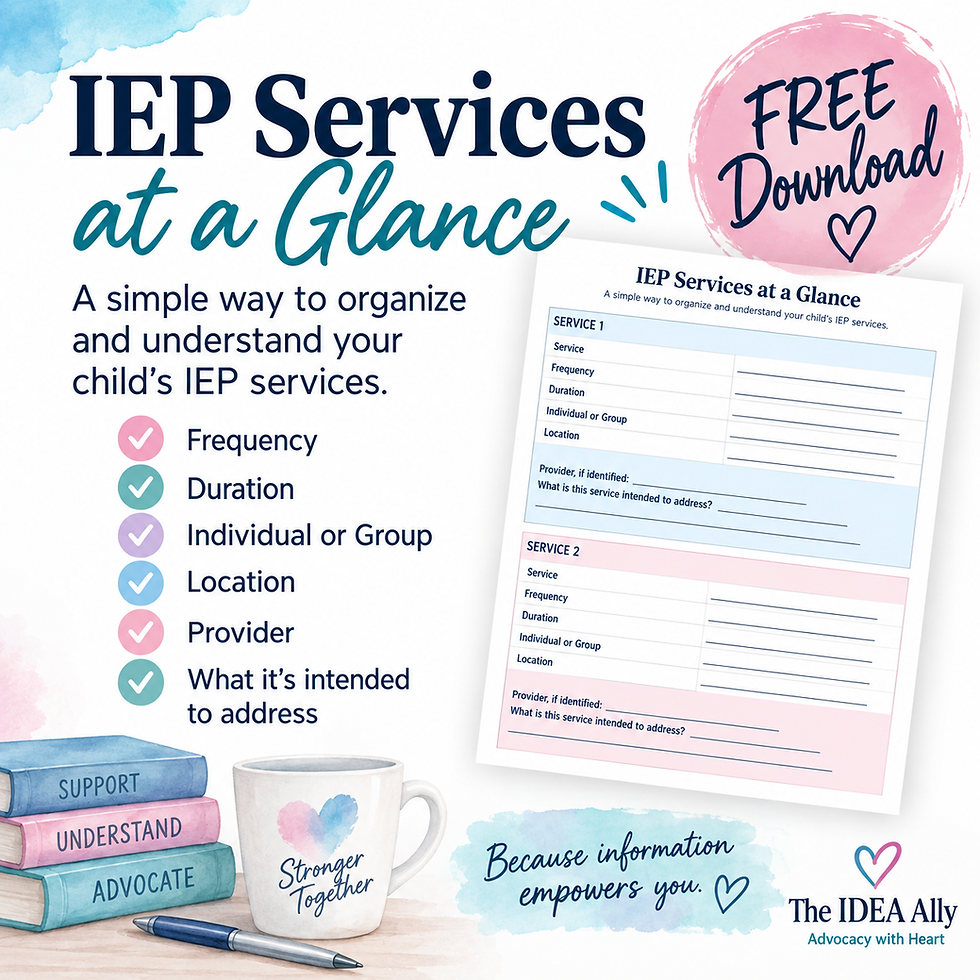
Take a few minutes to review your child's IEP and look at the services page.
Ask yourself:
Are the listed services the ones I expected?
How often are they supposed to occur?
Are they individual, small group, or in the classroom?
Does my child seem to be receiving those services consistently?
Sometimes parents are surprised to realize they remembered a conversation from an IEP meeting—but not what was actually written into the finalized plan.
Review the Accommodations
Next, look at the accommodations section.
These are the supports intended to help your child access learning successfully.
For example:
Extended time
Preferential seating
Frequent movement breaks
Copies of class notes
Reduced distractions
Visual supports
As you read through them, ask yourself:
Does this sound like what my child experiences every day?
If your child tells you they never receive extra time or consistently sits in the back of the classroom despite preferential seating being listed, make a note of it. You're simply gathering information at this stage.
Check the Goals
Goals are one of the most important parts of an IEP.
Each goal should address an area of need and include a way to measure progress.
Ask yourself:
What skills is my child expected to improve this year?
Do I understand each goal?
Have I seen evidence that these skills are being practiced?
You don't have to be an educator to notice whether your child is becoming more confident in an area or continuing to struggle.
Don't Forget Communication
Many IEPs also include communication expectations.
Perhaps the teacher agreed to send home a weekly update.
Maybe the team discussed a communication notebook or regular emails.
Ask yourself:
Is the communication happening as expected?
Am I receiving enough information to understand how my child is doing?
Good communication often prevents misunderstandings before they become bigger concerns.
Your Goal Right Now Isn't to Find Fault
As you review the IEP, remember that this isn't about looking for mistakes.
It's about understanding the plan so you can compare it with your child's daily experience.
The better you know the IEP, the more productive your conversations with the school can be.
💙 Your child's IEP isn't just a document to sign once a year—it's a working plan meant to guide every school day.
Looking Ahead
Now that you've refreshed your understanding of what the IEP says should happen, the next step is to compare that plan with your child's actual experience.
In Part 3: Compare the Plan With What Is Actually Happening, we'll explore how to determine whether services, accommodations, and supports are being implemented consistently—and what to do if they aren't.
Because understanding the plan is important...but making sure it's working in real life is what truly matters.
💙 I'll see you in Part 3
Helpful add-ons (free tools)
Next Steps and Resources:
The following websites are incredibly helpful when navigating the Special Education world. · www.wrightslaw.com
Need help personalizing your letter or planning next steps? I offer one-on-one support—virtual anywhere in the U.S. and in-person across NY/NJ. Work with me.
About the Author
Allison Rosenberg Meyerson is a special education advocate with 30+ years in the classroom and as a literacy specialist. She is Orton-Gillingham Certified, a COPAA SEAT 1.0 graduate, and a Dyslexia Advocate. Based in Warwick, NY, she supports families across NY, NJ, and virtually nationwide through The IDEA Ally.
Contact:
Website www.TheIDEAAlly.com
Email Allison@theideaally.com


Comments